Upcoming Release!
Paper Tombs: Post-Holocaust Memorial Books and Prewar Jewish Life
In the years after the Holocaust, Jewish survivors began compiling memorial books for the towns and communities that had been destroyed. These books, known in Yiddish as yizker bikher, were collective projects to preserve memories of places that no longer existed.
Paper Tombs examines the origins, structure, and meaning of these memorial books. Drawing on hundreds of examples published in Israel and the United States, the book explores how survivors reconstructed the social worlds of their towns through writing, photographs, maps, and art.
What People are Saying

In this moving, bold, and scholarly work, Jennifer Rich precisely captures the reasons why memorial books are so engaging and important. Not just informative and heartfelt, Paper Tombs functions in the same way as the books Rich so lovingly describes: as a matzeva or substitute gravestone.
~Dan Stone, Professor of Modern History, Royal Holloway, University of London, and author of The Holocaust: An Unfinished History
A deeply original, moving and personal study of post-Holocaust memory. Jennifer Rich analyzes how survivor-created memorial books preserved destroyed communities in text, image, and material form, transforming grief into collective remembrance. A powerful new contribution to Holocaust studies, this work reshapes how we understand survival and commemoration.
~Christine Schmidt, Co-Director, The Wiener Holocaust Library, London
Beautifully written and extensively researched, Jenny Rich's Paper Tombs takes us on a multi-sensory journey into the lost Jewish worlds captured in yizker bikher and opens our eyes to the lives of the individuals and communities who created them. By moving beyond the analysis of just the written word, Rich helps us understand how and why these repositories of memory were created and how their materiality is also a response to the violent and emotional rupture caused by the Holocaust.
~Caroline Sturdy Colls, author of Holocaust Archaeologies: Approaches and Future Directions
What the book reveals is that the study of the Holocaust goes on not only in great archives or along the tracks and fields and forests but in the small, personal products of everyday people. At a time when fewer and fewer people have the lived experience of capture and exile, the book exhorts us all never to forget. A moving testimony to a lost world and a goad to keep its memory alive.
~Kirkus Reviews
Other Books
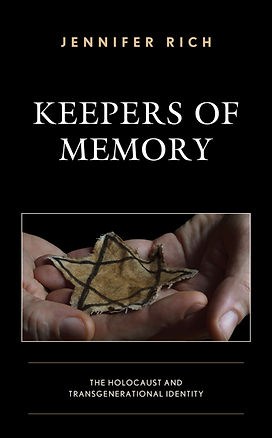
Keepers of Memory answers the question of how descendants of Holocaust survivors remember the Holocaust, the event that preceded their birth but has shaped their lives. Through personal stories and in-depth interviews, Rich examines the complicated relationship between history, truth, and memory. Keepers of Memory explores topics that include how stories of survival become stories of either empowerment or trauma for the descending generations, career choice as a form of commemoration, religion, and family life.
Ultimately, this work paints a compelling picture of the promises and pitfalls of memory and points to implications for memory and commemoration in the coming generations.
Politics, Education, and Social Problems considers how we can create social change by talking about politics and social problems in more open, direct, and inclusive ways in educational spaces. Drawing on data from a range of settings, this book closely examines how and when complicated conversations take place in classrooms, schools, and communities.
The book tackles a series of hot-button, timely issues, including race, religion, politics, and gender, and turns a critical eye to schools and the communities in which they are situated; the conversations adults have —and pointedly ignore — with one another; and, perhaps most critically, the politics that shape our society.
